
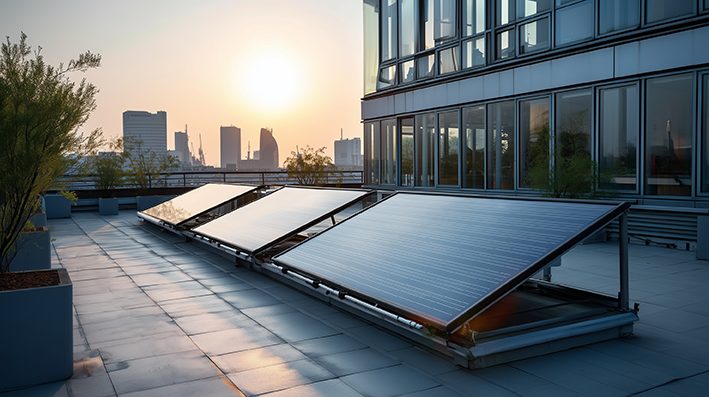
In the transition toward a net-zero economy, commercial building operators often find themselves staring at a roof and a spreadsheet, trying to bridge the gap between ambitious carbon targets and practical spatial constraints. While the spotlight shines on air-source heat pumps and solar photovoltaics (PV), when it comes to delivering a reliable, renewable alternative for water heating here is a quiet overachiever that remains one of the most space-efficient responses available: solar thermal.
Understanding the specific strengths of solar thermal, and the regulatory framework surrounding it, is essential for any effective decarbonisation strategy.
Solar thermal vs. solar PV
The debate between PV and solar thermal often comes down to a fundamental misunderstanding of energy conversion. Solar PV is a key tool for introducing sustainable generation into buildings, but when used specifically for heating water, it is an inefficient choice.
Modern solar PV panels typically operate at around 20% efficiency. To generate a yearly thermal output of 3,400 kWh, an installer would need approximately 20 m² of solar PV. In stark contrast, solar thermal collectors are designed specifically to produce thermal energy. This focus results in significantly higher peak outputs. That same 3,400 kWh requirement can be met by just 5 m² of solar thermal.
In the crowded environment of commercial roofing – where HVAC units and maintenance walkways compete for space – this 4:1 ratio is a gamechanger. The optimal approach is to size a solar PV array to match the building’s base electrical load and utilise solar thermal to meet the thermal load. By doing so, solar thermal can offset up to eight times as much CO₂ as solar PV per square metre.
Under Building Regulations Part L (Volume 2) which dictates the energy efficiency standards for non-domestic building, solar thermal provides a significant advantage in meeting the target primary energy rate (TPER) and target emission rate (TER). When calculating impact for a Part L submission, engineers focus on the solar fraction, calculated by dividing the solar energy contributed by the total hot water demand. For commercial premises, a target of 30–50% is common.
Because solar thermal produces heat directly without conversion, unlike electricity to heat, it is credited as a direct reduction in the building’s auxiliary energy demand. In the latest Part L updates, primary energy is the lead metric; and solar thermal scores exceptionally well here because it requires negligible electrical input. Only enough to power a small circulation pump.
The power of hybrid integration
Solar thermal rarely works alone; it is most effective as the pre-heat stage for a primary heating plant. In legacy gas-fired systems, solar thermal raises the cold feed temperature from 10°C to potentially 40–50°C. The gas water heater then only provides the necessary top-up heating to reach the 60°C required for pasteurisation. This reduces gas burner cycling, extending appliance life and slashing fuel consumption.
In electric systems, as buildings move away from gas, solar thermal becomes even more critical. Direct electric heating is expensive. While heat pumps are efficient, their coefficient of performance (COP) drops when worked hard to produce higher-temperature domestic hot water (DHW). Using solar thermal to pre-heat water allows the heat pump to operate at lower, more efficient temperatures for greater energy and cost savings.
For most commercial premises, installation is governed by Class J of Part 14 of the Town and Country Planning Order 2015. Many installations fall under ‘Permitted Development,’ with the notable exception of listed buildings, otherwise full planning permission may not be required. However, key exclusions do still apply.
On pitched roofs, solar equipment must not protrude more than 0.2 metres beyond the plane of the roof slope. Whilst on flat roofs, the highest part of the solar equipment must be no more than one metre above the highest part of the roof. Also, equipment cannot be installed within one metre of the external edge of the roof.
Recouping sustainability investment
The financial viability of solar thermal is driven by fuel offset and the price gap between fossil fuels and electricity. For properties on gas, offsetting can save £45-65 per m² of collector for an 8-12 year payback.
In an all-electric building, every kWh of solar heat collected is a 1:1 saving of the building’s most expensive utility. Savings by offsetting direct electric water heating can therefore range from £160-£220 per m² of collector for accelerated payback of just 4-6 years. Beyond the immediate energy savings, the primary ‘profit’ is often found in the extension of the water heater’s lifecycle. With a design life of solar thermal exceeding 20 years and minimal moving parts, and incorporation of drain back glycol protection in commonly deployed flat plate collectors, maintenance demands, and therefore total cost of ownership, remains remarkably low.
With solar thermal four times more energy-dense than Solar PV for heat generation, it is the superior choice for space-constrained sites. By acting as an essential pre-heat stage, it reduces the workload of boilers and heat pumps alike. For strategic decarbonisation, the math is simple: use PV for the base electrical load but let solar thermal handle the heavy lifting for hot water.
