
For commercial buildings a reliable hot water supply is an operational necessity. Achieving reliability requires balancing storage capacity, rapid recovery rates, and system resilience without overloading primary heat sources. Increasingly, the strategic selection of indirect, glass-lined carbon steel cylinders offers the ideal balance of capital economy and long-term durability, while meeting the challenges of fuel choices, energy efficiency, and water quality.
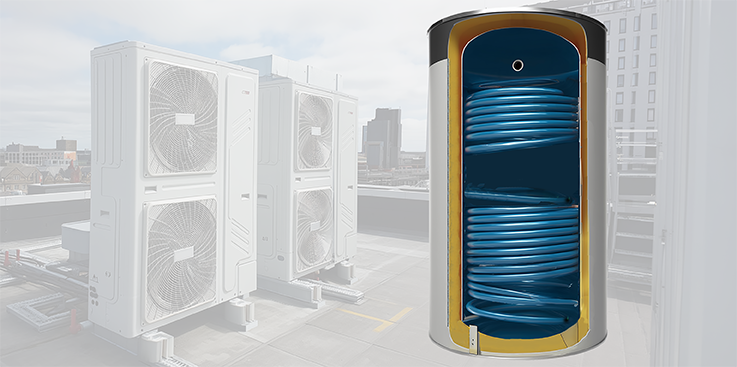
Unlike direct systems that use dedicated gas burners or internal electric elements, an indirect hot water cylinder, or calorifier, separates the heating fluid from the stored domestic hot water (DHW).The calorifier is a large, insulated tank equipped with an internal heat exchanger coil connected to an external heat source, such as a boiler, heat pump, or solar thermal array. As hot fluid circulates through the coil, it transfers thermal energy to the surrounding water in the tank, creating a massive, readily available hot water reservoir.
This approach to securing water heating is advantageous. By decoupling storage from heat generation organisation can change or mix energy sources. Calorifiers will seamlessly integrate traditional gas or electric boilers with low-carbon technologies like air source heat pumps or solar thermal collectors, satisfying corporate sustainability and net-zero targets. It is also a thermally efficient approach, as the heavy-duty tank insulation minimises standby heat loss. The stored water therefore stays hot longer, reducing frequent reheating cycles and lowering utility costs. Separating the primary heat source also helps to simplify upkeep. The tank requires minimal standalone attention, and external heating plant maintenance won’t directly compromise the stored water.
Integrating Renewables and Hybrid Technology
Shifting to low-carbon systems like air source heat pumps introduces distinct engineering dynamics. Heat pumps operate most efficiently during longer, continuous cycles at lower temperatures. To accommodate this, smart system design incorporates buffer vessels and multi-coil setups.
Buffer vessels act as thermal batteries. The heat pump deposits energy into the buffer at regular intervals, which then releases that heat when building demand outpaces immediate heat pump production, preventing inefficient short-cycling.
Dual, or twin-coil arrangements are also essential for hybrid setups. A typical layout uses an air source heat pump on the lower coil for high-efficiency baseline pre-heating, while an upper coil fed by a primary electric or gas boiler to meet necessary working temperatures and provide rapid high-temperature top-ups during peak demand.
Correctly sizing such commercial cylinders depends heavily on occupant volume, peak demand periods, required recovery times, and primary heat source capacity. While standard commercial installations are typically sized between 30 and 50 litres per occupant for DHW demand alone, requirements fluctuate based on building use. A commercial kitchen demands high-temperature water continuously, whereas an office experiences brief, intense morning and lunch peaks. The prevalence of heat pumps in new builds has also resulted in a need for larger buffer vessels which must be accommodated in a specification.
Furthermore, modern designs favour unvented cylinders over traditional vented models. By connecting directly to the mains water supply, unvented systems deliver high-pressure hot water evenly to multiple showers and taps simultaneously, eliminating the need for cold water storage tanks. These high-performance setups require specialist G3 safety compliance, which qualified engineers must execute. To accommodate these needs, cylinders need to be offered ‘off-the-shelf’ in a range of sizes to meet most commercial applications, and in common replacement scenarios be able to meet the requirements of existing vented, or new, unvented specifications.
Why Glass-Lined Steel?
Selecting the right cylinder material requires understanding local water chemistry, which varies significantly across the UK and profoundly impacts component lifespan. Hard water areas are prone to severe limescale accumulation, particularly where water encounters high-temperature surfaces like direct electric immersions. Scale accumulation actively degrades heating efficiency and causes premature element failure. Configuring a carbon steel cylinder as an indirect calorifier helps mitigate this issue. Using an internal coil rather than a direct element drastically reduces direct contact between raw mains water and high-temperature surfaces, suppressing scale formation. As such, high-quality glass-lined carbon steel cylinders, with regular maintenance provide an excellent, lower-cost option in these regions.
The problems traditionally have sat with areas of very soft water. This will aggressively corrode bare or treated metal, making more expensive premium stainless steel necessary. Our understanding off corrosion and protective tank lining chemistry is much improved today. With application of protective inorganic blue enamel, or ‘glass-lining’, and the inclusion of a sacrificial anode, corrosion can also be abated in treated steel vessels, providing consistent corrosion defence and an extended operational life, even is softer water areas.
To meet the demand for versatile, cost-effective commercial storage, hot water specialist Adveco offers the VB range of low-cost carbon steel storage tanks. This off-the-shelf family of vessels supports direct electric heating, buffer storage, indirect heating, and preheat configurations.
Built to handle diverse UK water conditions, the VB range supports working pressures up to 8 bar and temperatures up to 85°C. Every tank features a tough, corrosion-resistant inorganic blue enamel lining and a magnesium sacrificial anode. Thermal protection is provided by rigid high-density polyurethane foam insulation (200–500L models) or a removable polyester fibre jacket (750–3000L models). Maintenance is streamlined via a front-facing, leak-resistant cleanout flange.
The range features three purpose-built configurations:
Adveco VBI (Indirect / Preheat) available from 200 to 3000 litres. The VBI supports all-electric systems. It pairs with Adveco direct electric immersions from 3 to 36 kW, plus 3 to 6 kW secondary backup immersions for guaranteed continuity.
Adveco VBT (Twin-Coil Calorifier) also ranging from 200 to 3000 litres. The VBT features low- and high-level fixed coils designed for two separate heat sources, making it the definitive option for hybrid renewable/boiler configurations.
Adveco VBB (Single-Coil Buffer) available from 200 to 2000 litres. The VBB features a single low-level coil. It is ideal for optimising heat pump operations or acting as an indirect preheat vessel, and it accommodates a 3 to 36 kW electric immersion heater.
Selecting the proper hot water infrastructure is a balancing act between initial expenditure, operational efficiency, and long-term reliability. By investing in high-quality, glass-lined carbon steel calorifiers like the Adveco VB range, commercial operators achieve lower running costs, excellent fuel flexibility, and a resilient, future-ready foundation for low-carbon building operations.