

Whether newly constructed or undergoing retrofit, commercial buildings across the UK share a broadly consistent set of priorities: sustainability credentials, regulatory compliance, operational efficiency, energy performance. These are the metrics that drive specification decisions, influence procurement, and shape the conversations between engineers, consultants and building operators.
And yet, for all the focus on future-ready design, water disinfection remains a discipline where many projects default to legacy practice without properly weighing up the alternatives. That disconnect has consequences, for plantroom design, for ongoing compliance, and increasingly for a building’s ability to meet the sustainability targets it has been designed to achieve.
The problem with bulk dosing
Bulk sodium hypochlorite dosing has long been the standard approach to water disinfection across commercial estates. It’s familiar, widely available and broadly understood. But familiarity and suitability are not the same thing.
Stored hypochlorite is an unstable compound. It degrades over time, accelerated by heat, light and extended storage, which means the effective concentration in a bulk tank is not fixed. It reduces.
Buildings relying on stored solution for consistent disinfection are, in effect, dosing from a chemistry that is always in decline from the moment it’s delivered. Maintaining reliable residual levels demands constant adjustment, and the margin for error narrows as the solution ages.
Beyond dosing accuracy, bulk storage introduces a distinct set of operational and safety considerations. Chemical deliveries require dedicated storage, appropriate containment, control of access, and robust handling procedures. In buildings such as hotels, healthcare facilities and commercial offices, these requirements add complexity and create ongoing risk exposure that facilities teams and engineers are increasingly, and understandably, unwilling to accept.
Electrochlorination changes all that
By contrast, electrochlorination generates sodium hypochlorite on-site, on-demand, from salt, water and electricity through an electrolytic process. The chemistry is not new, but the systems that deliver it have advanced considerably.
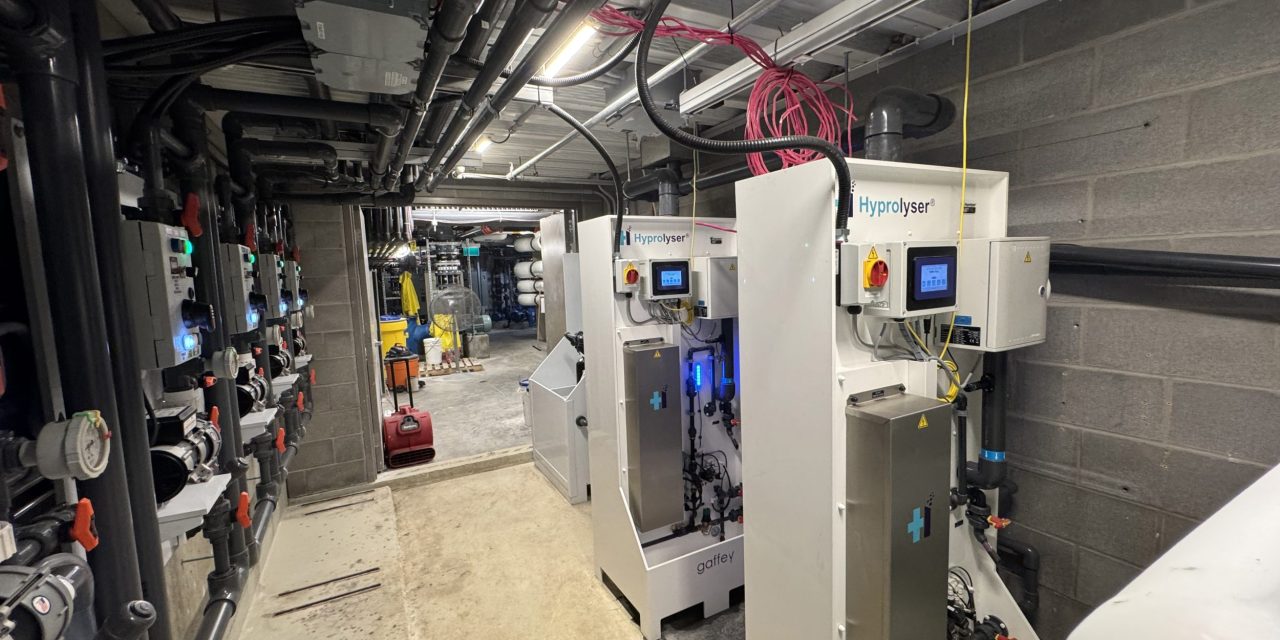
Today’s electrochlorination platforms, including our Hyprolyser® iSEC® range, are compact, modular and capable of seamlessly integrating into building management systems, generating precise, consistent concentrations of biocidal solution without the storage, transport or handling risks associated with bulk chemical supply. Our patented vacuum blending technology ensures a hyper-accurate rate of flow for precise chemistry blending and consistent chlorine concentration. Equally significant is the IoT platform now built into our current generation of systems. Remote access via mobile, tablet or desktop gives different levels of users a tailored view of system performance: engineers can access full diagnostics and carry out remote maintenance; service partners can manage equipment and generate compliance reports; and building operators can monitor system status and verify disinfection performance in real time.
The process itself produces a fresh, lower-concentration hypochlorite solution at the point of use. And because it’s generated continuously and used almost immediately, there is no degradation. Dosing is more predictable, residuals are more stable, and the disinfection performance is easier to validate and audit.
Simplifying the plantroom
Removing bulk chemical storage from the plantroom equation has a direct impact on design. The footprint associated with chemical storage, secondary containment, ventilation requirements and delivery access is released. Pipework configurations become cleaner. The number of potential failure and compliance points reduces, and maintaining spaces becomes easier.
For retrofit projects, where plantroom space is often constrained and every square metre matters, the effect of this simplification can often be significant. For new builds, specifying electrochlorination from the outset removes an infrastructure burden before it’s even created.
Less chemical, less risk
Minimising chemical storage in occupied buildings is not solely an operational consideration, it’s a safety and liability one. Concentrated hypochlorite requires careful management, and the risks associated with inappropriate handling, storage failures or accidental exposure are by no means trivial. On-site generation reduces the volume of hazardous material held on site at any given time and limits the number of personnel required to handle it. It also removes the dependency on external supply chains that can, and often do, experience disruption.
Reduce carbon cost
The sustainability case for electrochlorination is also more quantifiable than it might first appear; cutting out regular chemical deliveries removes associated transport emissions and the carbon cost of manufacturing, packaging and distributing concentrated hypochlorite. Chemical waste from degraded or unused stored solution, a genuine issue with bulk dosing, is also eliminated. For buildings pursuing BREEAM ratings, NABERS certification or net zero operational targets, these are measurable gains that sit within the scope of water management strategy.
Timing matters
There’s little doubt, the most effective way to realise all these benefits is at the specification stage. Electrochlorination systems are not difficult to retrofit, but factoring them in from the outset, in terms of plantroom layout, electrical supply and system integration, delivers better outcomes and lower whole-life costs than having to engineer them in down the line. Modern systems are available off-the-shelf with short lead times and can be commissioned quickly once on site, meaning the practical barriers are lower than many engineers expect.
Water disinfection infrastructure influences building performance in ways that too rarely feature in early-stage design conversations. Successful projects, whether new build or retrofit, are defined by the decisions that go beyond the obvious: the ones that factor in operational resilience, whole-life cost, safety and sustainability together.
Innovation in water treatment technology has reached a point where on-site generation is a practical, proven option that belongs in the specification conversation for any commercial project that takes a genuinely future-facing approach. The technology exists, the case is clear, and the buildings that perform best over time will be the ones where it’s considered from the start.
For more information on Gaffey’s Hyprolyser® iSEC® electrochlorination systems, visit gaffeytechnology.com.