
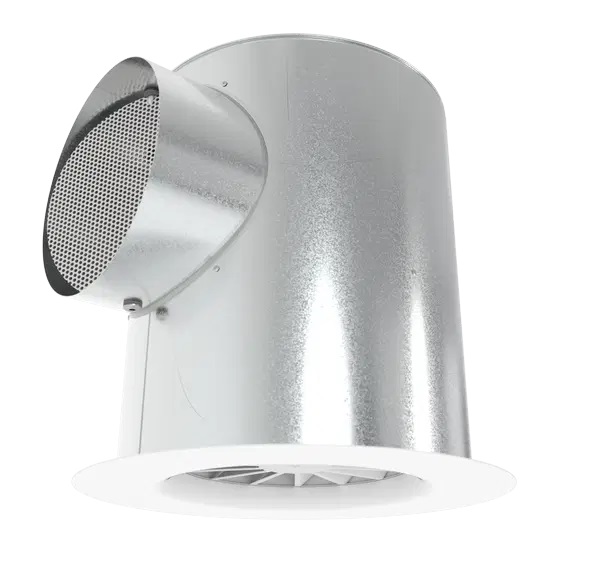
Exposed ceilings are a key feature in today’s architectural designs, but the absence of an adjacent ceiling surface involves air movement problems such as ‘dumping’ of cool air or ineffective heating in the occupied zone. The new RFD-V diffuser from TROX, which has been purpose-designed for use in free-hanging applications, addresses these challenges, providing more effective control of air movement and improving comfort conditions in spaces with exposed ceilings.
In a typical mixed air distribution system, Coanda effect is exploited to cause the air discharged from the diffuser to move across the ceiling. This throw distance along the ceiling gives the air a chance to slow down, to ensure it is delivered into the occupied zone at a reduced velocity to avoid occupancy discomfort. This avoids draughts, or ‘dumping’ which would occur if the air enters the occupied zone too soon. TROX has developed two products in recent years – the RFD-DX and Tellus diffusers – which address these issues. Many systems, however, need to both cool and heat. Heating is a particular challenge where diffusers are free-hanging because, without a ceiling, there is nothing to prevent the warm air for exiting the diffuser and stratifying without providing any heat to the occupied zone. This wastes energy, and room occupants can experience a high temperature difference between head and ankle height. Solutions utilising external electrical actuators can tackle the problem, but involve additional cost, wiring and technical complexity.
The new TROX RFD-V, however, addresses the challenges of heating and cooling in spaces with exposed ceilings by harnessing innovative technology built into the diffuser itself. The RFD-V is an adjustable swirl diffuser with an integral thermal actuator. An adjustable internal sleeve enables the unit to move between horizontal and vertical air discharge, depending on whether the system needs to cool or warm the space.
During cooling the air discharge is horizontal and radial. As the supply temperature increases the discharge pattern will switch automatically to vertical, directing warmer air more effectively into the occupied space. Once the supply temperature decreases, the air discharge switches back to horizontal once more. These changes to air discharge are controlled by an integral thermal actuator, within the diffuser which, in turn, controls the internal sleeve. The supply air to room air temperature difference may range from -10 to +15K. To give rooms an aesthetic, uniform look, type RFD-V diffusers may also be used for extract air.
Tim Tanner, Product Technical Manager – Ventilation Technology, TROX UK commented: “The effectiveness of the RFD-V was shown in mock up winter start-up tests held in the TROX UK labs. The objective was to warm a 36m2space from 160C to 210C with a supply air of 148l/s at a temperature of 300C. With the standard RFD the test took 58 minutes, but with the RFD-V this was greatly reduced to only 10 minutes. The RFD-V also performed better when it came to thermal comfort.”
In addition to the ability to adjust air discharge pattern in line with supply temperature, the new TROX RFD-V has additional design features to improve comfort conditions in rooms with exposed ceilings, and to simplify and speed-up installation and commissioning. For more effective cooling, the RFD-V has been designed with an extended discharge nozzle which provides rapid and more effective cooling in exposed ceiling applications whilst simultaneously preventing draughts. When heating, the RFD-V’s vertical air discharge improves comfort conditions and energy efficiency, whilst also preventing the dumping of air. The fixed blades and minimal change to pressure drop between horizontal and vertical also contribute to energy efficient operation throughout the lifetime of the diffuser. In addition, a number of features increase ease of installation and maintenance. There is no need to supply power or control to the diffuser, as the necessary technology is already integral, and the unit has two fixing methods for ease of installation and maintenance. Commissioning is simple, via the diffuser’s pressure diaphragm.
Importantly, of course, the RFD-V enables the architect to achieve the aesthetic objectives for the design of the space, whilst ensuring that the comfort conditions and energy efficiency of the building can meet the same high standard.