
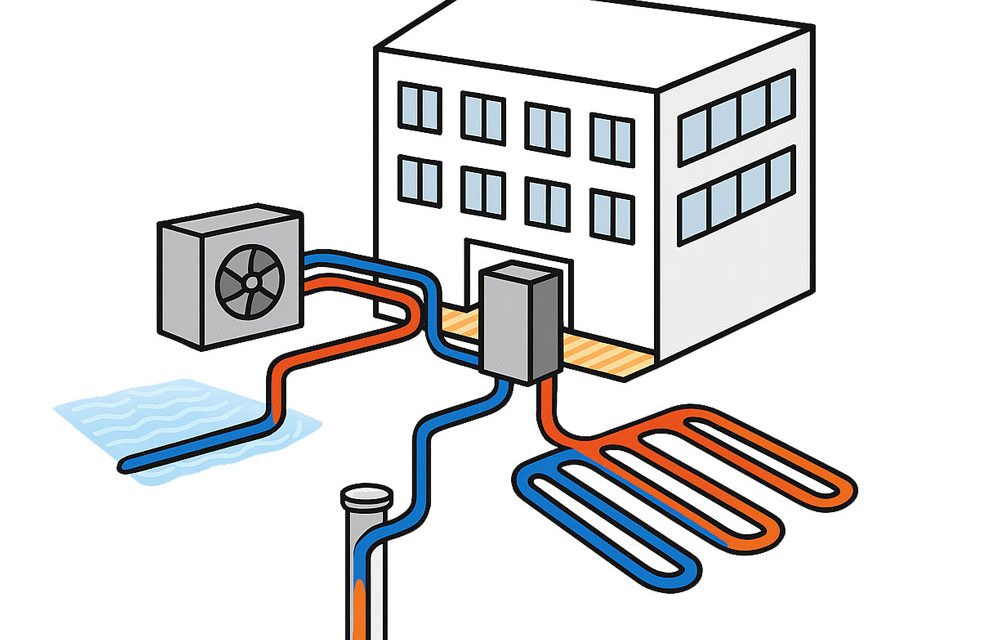
Rinnai’s Peter Seddon explain s how heat pump technology in commercial applications can improve system efficiency and contribute towards national decarbonisation targets. Heat pumps are fast becoming a widespread and viable option for business owners who require heating and hot water. Find out how investing in a heat pump can benefit commercial projects.
Heat Pumps are a viable technology that efficiently provides warmth and heated water. Although the UK is still reliant on fossil fuels, heat pump adoption is a growing trend amongst UK customers. Currently just 1% of homes use heat pumps as a primary source of heating and hot water. For every heat pump sold, there are 15 gas boilers purchased.
But, as of 2024 UK heat pump sales were recorded at 98, 345, up from 62,906 from 2023. Between 2025 and 2030 the UK heat pump market is expected to expand by 11.10% CAGR. So, how can a heat pump benefit the property of a business owner or homeowner?
Rinnai can demonstrate the benefits of real-life heat pump installations through three separate case studies that display the advantages of heat pump adoption in a commercial application.
Case Study 1
The location is a three-story Welsh science park with a BREEAM excellent facility providing offices, laboratories, and workshops for up to 700 people. It functions as a central hub for start‑ups, research teams and established technology‑focused organisations.
Wales’s first dedicated science park selected a custom Rinnai R290 High Temperature ASHP system with full Modbus BMS integration to support its low carbon heating and hot water strategy. The installation includes ten 27 kW R290 heat pumps, sourced from Rinnai’s 21–27 kW R290 range.
Each unit delivers a SCOP of 3.21 at a 65°C flow temperature, supported by a custom designed 3000‑litre buffer vessel engineered specifically for the site’s needs. The system is capable of producing high temperature output up to 75°C, and all units were supplied with anti‑corrosion protection to ensure durability in the park’s coastal environment.
The science park required a robust, energy efficient, low carbon heating and hot water system suitable for a large mixed-use building. Specific needs included:
- High water temperatures for diverse building demands
- Meaningful carbon reduction to support sustainability goals
- Strict height and weight limitations for rooftop installation
- Resistance to corrosion due to coastal air conditions
To meet these challenges, the client sought a partner offering custom engineering, technical expertise, and full mechanical design support. The science park selected Rinnai after assessing the company’s R290 high temperature heat pump range, technical capability, and in‑house design experience.
Rinnai delivered a complete, site-specific solution including:
- 10 × 27 kW R290 ASHP units, each treated with anti‑corrosion coating for coastal protection.
- A custom built 3000 L buffer vessel engineered for mechanical compatibility
- Full Modbus BMS integration for streamlined control
- Optimised rooftop configuration to minimise height and distribute system weight
Rinnai’s R290 technology is low-gwp, quiet operation, enables water temperatures up to 75°C, and ensures compliance with European F‑Gas phase‑down regulations. For tailored system selection the client also accessed Rinnai’s design support tools.
The science park now benefits from a future proof, low carbon heating and hot water system that reduces operational impact while maintaining high performance.
Key outcomes include:
- Meaningful carbon reduction through R290 low GWP refrigerant
- High temperature output suitable for laboratories, offices, and workshops
- Greater energy efficiency, supporting long term cost control
- Resilient system performance with anti‑corrosion protection
- Seamless BMS integration for optimal operation
The Rinnai range also includes scalable larger systems for future expansion, such as the 40–410 kW R290 commercial series.
The Welsh science park now operates a reliable, efficient, and low carbon heating and hot water system aligned with long term sustainability goals.
Case Study 2
 An additional example of Rinnai’s heat pumps providing operational efficiency to a commercial site is located at a landmark commercial office development in central London that required a high-performance domestic hot water (DHW) solution capable of meeting peak occupier demand while fitting within a tightly constrained plantroom envelope.
A leading building services engineering consultancy worked with Rinnai’s low GWP commercial heat pump technology to design a DHW system comprising two 40kW R290 air source heat pumps, complete with plate heat exchangers and DHW storage.
The resulting solution successfully meets a daily hot water demand of approximately 1,600 litres, achieves a rapid recovery time of around 85 minutes at –7°C ambient temperature, and delivers a future ready, low‑GWP refrigerant strategy with integrated safety and control measures embedded into the system design.
To explore Rinnai’s full commercial product range: https://www.rinnai-uk.co.uk/products
The client is a leading independent, global multi-disciplinary consultancy delivering innovative and sustainable engineering solutions for complex commercial developments. The practice is particularly experienced in the delivery of Grade‑A office buildings, where plant space optimisation, resilience, and low‑carbon performance are critical to both landlord and occupier requirements.
The office building required a domestic hot water system capable of supporting a daily demand of approximately 1,600 litres, with a maximum recovery period of 120 minutes, to ensure reliable service during peak occupancy.
Key challenges included:
- Highly constrained plantroom space, typical of dense city‑centre office developments
- The need for robust winter performance
- Compliance with evolving refrigerant and decarbonisation legislation
- Confidence in system safety and long-term operational resilience
Design performance was assessed at –7°C ambient temperature, ensuring reliable hot water availability even under peak winter conditions.
The Solution
Rinnai UK worked collaboratively with the project team to develop a high‑temperature R290 air source heat pump solution, specifically configured for commercial DHW production within a restricted plant environment.
The proposed system used two 40kW R290 inverter monoblock air source heat pumps, supported by high‑temperature plate heat exchangers, inline buffer vessels, and DHW pre‑feed storage, ensuring both hydraulic stability and rapid recovery performance.
To learn more about Rinnai’s R290 commercial heat pump range: https://www.rinnai-uk.co.uk/products/commercial-heat-pumps
Key system components included:
- 2 × 40kW R290 high temperature air source heat pumps
- Brazed high temperature plate heat exchangers, providing hydraulic separation.
- Inline buffer vessels, maintaining minimum primary water content.
- 800L PHE pre‑feed vessels, supporting peak DHW demand and recovery.
- Modbus activation, enabling seamless future BMS integration.
- Integrated refrigerant gas leak detection, enhancing on‑site safety.
The final design delivered a calculated DHW recovery time of approximately 85 minutes, comfortably exceeding the original performance requirement.
“The solution provided both the recovery performance and sustainability credentials required for a high‑specification commercial office environment.”
— Building Services Consultant
For support with system selection and early‑stage design: www.rinnai-uk.co.uk/contact-us/help-me-choose-product
The proposed DHW system delivered multiple performance and operational benefits aligned with modern office development expectations:
- DHW recovery achieved in under 90 minutes
- Reliable winter performance validated at –7°C ambient.
- Low‑GWP R290 refrigerant, supporting future F‑Gas and decarbonisation compliance.
- Enhanced system safety, via integrated refrigerant gas detection
- Flexible monitoring and control, enabled through Modbus connectivity.
Rinnai UK’s early design engagement helped provide confidence from concept stage through to proposed installation, supporting both technical compliance and broader sustainability objectives.
This project demonstrates how early collaboration and thoughtful product selection can deliver a high performance, low carbon DHW solution suited to the challenges of central London office developments, without compromising on safety, resilience, or space efficiency.
By combining the consultancy’s engineering expertise with Rinnai UK’s R290 heat pump technology, the project team achieved a future‑ready solution aligned with landlord, occupier, and decarbonisation goals.
Case Study 3
A final example of the positive impact that Rinnai heat pump systems are demonstrated by the installation of a cascade of R290 air source heat pumps with thermal store, at a well-established, publicly accessible visitor attraction focused on environmental education and community engagement. The site required a future proof heating system aligned with its sustainability ethos.
A UK-based public visitor attraction within the environmental and education sector implemented a low carbon heating upgrade using a cascade of R290 air source heat pumps integrated with a thermal store. The system delivers a total of 71.2kW of heating output at design conditions and has been engineered to provide high temperature performance with a 70°C flow. As a result, the solution achieves improved energy efficiency while significantly reducing the site’s overall carbon impact, supporting both operational performance and sustainability goals.
Problem
The client needed to upgrade to a low carbon heating system while maintaining high-temperature performance suitable for existing infrastructure.
A key technical challenge was achieving reliable output at low ambient temperatures (-4°C) without compromising efficiency. Traditional systems raised concerns around rising operational costs and carbon emissions.
For more information, see UK strategy for low-carbon heating and buildings.
“We needed a solution that would deliver both performance and sustainability, without compromising on reliability during colder periods.”
Solution
A cascade system incorporating two 50kW R290 air source heat pumps was selected from the Rinnai low-GWP heat pump range.
R290 refrigerant was chosen due to its very low global warming potential and high efficiency performance, helping meet decarbonisation goals.
System design highlights:
- Designed to operate at 70/65°C (flow/return) at -4°C ambient
- Output at design conditions: 35.6kW per unit (71.2kW total)
- Nominal flow rate: 2.148 L/s per ASHP
- Head pressure: ~105 kPa (with pump kit)
The system utilised a cascade configuration—supported by Rinnai’s modular approach to heat pump design, enabling multiple units to operate efficiently together.
A thermal store was integrated between the primary and secondary circuits to optimise system stability and demand response. The secondary circuit operated at 70/59°C, requiring careful control of return temperatures.
Close coordination ensured consistent 70/65°C operation between the ASHP cascade and thermal store, maintaining optimal performance across the system.
“The cascade design allowed us to balance load efficiently while ensuring the system could meet peak heating demands.”
The completed system successfully delivered a high performance; low carbon heating solution tailored to the client’s requirements.
Key outcomes:
- Reliable high temperature heating, even in winter conditions
- Reduced carbon footprint through use of R290 refrigerant
- Improved system efficiency via precise flow/return temperature management
- Flexible, scalable cascade system for resilience and load matching
The use of advanced R290 heat pump technology allows systems to deliver hot water temperatures up to ~75°C, making them ideal for retrofit and high demand applications.
“The system has given us confidence in both performance and energy efficiency—it’s a future proof solution.”
This project highlights how modern heat pump technology, such as the Rinnai commercial heat pump range, can successfully deliver high temperature heating in complex, real-world environments.
Commercial heating will be dictated by the decision to embrace wider electrification throughout the UK. To prepare for this transition commercial and domestic property owners should be aware of the various heat pumps that are available on the open market.
Rinnai’s range of R290 and low-GWP high temperature commercial heat pump technology consist of a wide range of models extending from our large residential air source heat pump range, which includes models between 6kW to 27kW, making them a flexible option for your hot water and central heating needs.
Rinnai’s commercial heat pumps are available from 40kW to 110kW models that are proven to lower energy bills versus some conventional heating systems including fossil fuel boilers. The commercial range also used natural refrigerants such as R290.
To take advantage of Rinnai Design Support Services and review the ideal solution to reduce energy costs, maximise return on investment and apply renewable energy sources and lower carbon footprints, invest in a Rinnai heat pump.