
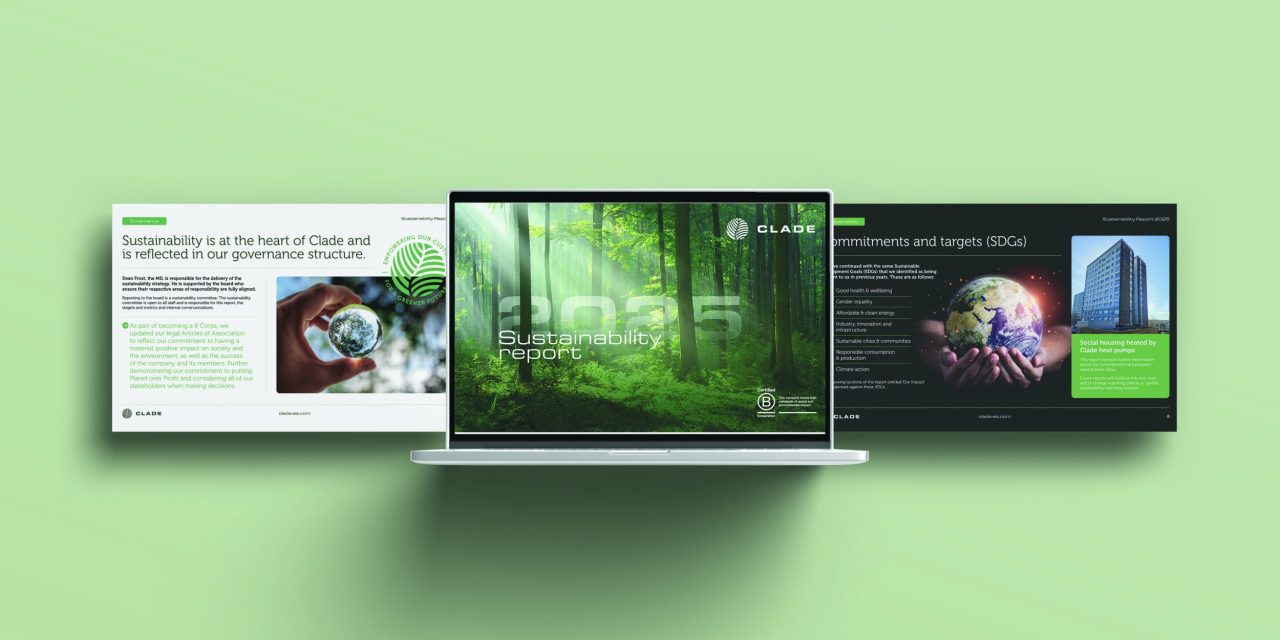
Clade Engineering Systems, a leading specialist in natural refrigerant heating and refrigeration products, has published its fifth annual Sustainability Report, setting out the company’s progress across carbon reduction, responsible business practice, product innovation and customer impact in the transition to a low carbon built environment.
The 2025 Sustainability Report highlights a year in which energy security has become an increasingly important driver for building owners and operators, alongside the continuing requirement to reduce carbon emissions. Against this backdrop, Clade emphasises its commitment to natural refrigerants with their low global warming potential (GWP) and highlights the benefits of natural refrigeration heat pumps. It states that products delivered in 2025 are proposed to save more than 2,000 tonnes of CO₂ emissions per year for customers – the equivalent of driving almost 5 million miles in a petrol car! –
Product innovation is another major theme of the Sustainability Report. In 2025, Clade developed an Ultra Low Noise heat pump to address acoustic performance, and a high-efficiency cooling heat pump in response to the growing challenge of building overheating.
Clade has also introduced manufacturing and material efficiency improvements, including increased use of common housings and components across product ranges, redesigned frames and housings to reduce metalwork, and the use of cleaner steels and alternative materials. These changes are intended to simplify the supply chain, improve efficiency on the shopfloor and reduce waste.
Clade’s own operational progress is detailed in the report. Total emissions reduced from 599.23 tonnes CO₂e in 2024 to 574.88 tonnes CO₂e in 2025, with net emissions reducing from 481.23 tonnes CO₂e to 454.72 tonnes CO₂e. The company also reports that 58% of its vehicle fleet is now electric, while its 137kWp solar panel array at the Leeds Technology Centre has saved 86,195kg of CO₂ since installation in September 2021.
Dean Frost, Managing Director at Clade Engineering Systems, said: “This year has underlined the importance of resilient, low carbon heating solutions for the built environment. Energy security is now sitting alongside carbon reduction as a primary market driver, and electrification, supported by a resilient grid, offers the most secure route forward. At the same time, the climate challenge has not gone away, and customers continue to need practical, commercially viable ways to reduce the carbon impact of their buildings.
“Our focus is on leading that transition with natural refrigerant technology, strong project delivery and long-term service support. The progress set out in our latest Sustainability Report reflects both the impact of the systems we deliver for customers and the steps we are taking to improve our own operations.”
Looking ahead, Clade has committed to reaching net zero in Scope 1 and 2 emissions by 2050, improving Scope 3 reporting, transitioning to an all-electric fleet, reducing waste in manufacturing and continuing to improve its B Corp score. The company also states that setting a 1.5°C SBTi net zero target will be a focus for future carbon reduction.
Dean concludes: “We have made significant progress, but we recognise there is more to do. Our ambition is to continue reducing our own impact while helping customers in the HVAC and built environment sectors decarbonise in a way that is practical, resilient and commercially deliverable.”