Air source heat pumps (ASHPs) have moved rapidly from being a niche sustainability technology to becoming a central consideration in the future of commercial domestic hot water (DHW) generation. As organisations across the UK seek to reduce carbon emissions and improve ESG performance, increasingly stringent building regulations have positioned heat pumps as one of the few viable pathways, particularly for new builds, towards low-carbon hot water production.
The appeal is obvious. Unlike conventional boilers, ASHPs do not generate heat through combustion. Instead, they use electricity and a refrigerant circuit to extract thermal energy from ambient air and transfer that energy into a DHW system. Under favourable conditions, modern systems can achieve coefficients of performance (COP) of three to four, meaning they deliver three to four units of heat for every unit of electricity consumed. This efficiency enables significant carbon reductions compared with direct electric water heating and offers a practical route to lowering building emissions.
Policy and regulation are also accelerating adoption. Building decarbonisation remains a critical component of the UK’s net-zero strategy, with heat pumps widely regarded as a principal technology for reducing emissions from residential and non-domestic buildings. Government policy continues to support electrification of heat, while investment programmes reinforce expectations that heat pump deployment will increase substantially through the coming decade. Low-carbon heating technologies are moving from an optional sustainability measure to an increasingly important element of future building compliance.
However, the reality of commercial DHW provision is more complex than many discussions around heat pumps suggest.
Commercial buildings such as hotels, student accommodation, care homes, healthcare facilities, leisure centres and educational establishments demand large volumes of hot water, often within concentrated peak periods. They are also subject to strict legionella prevention requirements, requiring stored water temperatures of at least 60°C. Heat pumps, by contrast, achieve their highest efficiencies at considerably lower temperatures.
This creates the key challenge for commercial deployment. While an ASHP can efficiently raise incoming water temperatures to around 55°C, consistently achieving higher temperatures results in reduced efficiency and increased electricity consumption. Operational costs therefore rise quickly. Higher-temperature ASHPs also carry a higher price tag and are often larger and heavier, making installation more complex. In addition, the European Union’s F-Gas Regulation 2024/573 has accelerated the move towards lower-GWP alternatives to traditional hydrofluorocarbon (HFC) refrigerants. As a result, natural refrigerants such as carbon dioxide (CO2) and propane (R290), which enable higher temperature production, are attracting significant attention.
However, refrigerant choice cannot be based solely on environmental or heat-generating credentials. CO2 systems can present operational challenges in certain DHW applications, while propane’s classification as a highly flammable refrigerant requires careful consideration. Industry bodies such as BESA have issued guidance covering risk assessment, installation practices, ventilation requirements and specialist engineer training. At Adveco, we have taken the decision not to carry large ASHPs using propane in favour of more compact, lightweight and lower-cost R32-based systems such as our current ADV-W range. We believe propane units should only be deployed for smaller-scale projects until safety concerns are fully addressed.
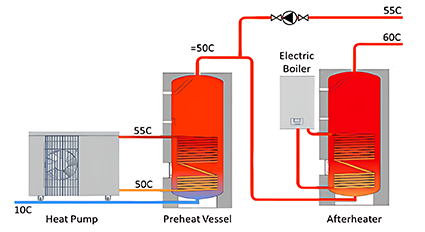
Designing a successful commercial DHW system is less about maximising heat pump output and more about integrating the technology intelligently. Hybrid systems are increasingly becoming the preferred response. In these configurations, heat pumps provide the bulk of the annual energy input, operating continuously within their most efficient range. Secondary heat sources, preferably electric boilers, are then used to provide temperature uplift and meet peak demand requirements. Coupled with appropriately sized thermal storage, this approach allows organisations to maximise carbon savings while maintaining reliable hot water provision.
Storage itself is becoming increasingly important in low-carbon DHW design. Traditional gas-fired systems were often designed around high heat input and relatively small storage volumes. Heat pump systems work more effectively when this principle is reversed. Larger cylinders enable water to be heated gradually over longer periods, allowing the heat pump to operate steadily and efficiently while ensuring sufficient reserves are available during peak demand. The success of a commercial heat pump project depends as much on system design and storage strategy as on the heat pump itself.
For building owners and estates managers considering a transition to heat pumps, the most important recommendation is to avoid a technology-led decision and instead focus on building demand. Robust metering, detailed consumption analysis and accurate assessment of peak load requirements should always precede system selection. A well-designed hybrid heat pump system, such as Adveco’s award-winning FUSION, will likely outperform a larger standalone heat pump installation in terms of both efficiency and lifecycle value.
Ultimately, air source heat pumps have established themselves as a proven technology for well-designed commercial DHW applications. They are not a universal replacement for every boiler plant, nor are they a silver bullet for decarbonisation. Their greatest value lies in their ability to form part of a carefully engineered low-carbon hot water strategy. Those that approach deployment pragmatically, combining heat pumps, storage and intelligent system integration, will be best positioned to reduce operating costs and emissions while creating resilient hot water systems fit for a net-zero future.